What Characteristics Make Up Christian Art From the Early Middle Ages?
The beginnings of an identifiable Christian art tin can exist traced to the end of the second century and the beginning of the third century. Because the Old Testament prohibitions confronting graven images, information technology is important to consider why Christian art adult in the first place. The use of images will be a continuing issue in the history of Christianity. The best caption for the emergence of Christian art in the early on church is due to the important role images played in Greco-Roman culture.
As Christianity gained converts, these new Christians had been brought up on the value of images in their previous cultural feel and they wanted to go on this in their Christian experience. For example, there was a change in burying practices in the Roman earth away from cremation to inhumation. Outside the city walls of Rome, adjacent to major roads, catacombs were dug into the basis to bury the expressionless. Families would accept chambers or cubicula dug to coffin their members. Wealthy Romans would also take sarcophagi or marble tombs carved for their burial. The Christian converts wanted the same things. Christian catacombs were dug frequently adjacent to not-Christian ones, and sarcophagi with Christian imagery were apparently popular with the richer Christians.
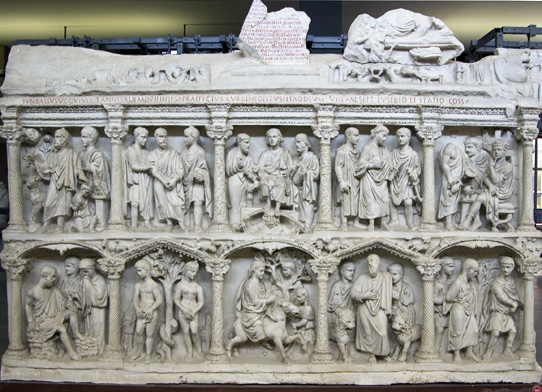
Sarcophagus of Junius Bassus, 359 C.Eastward., marble (Treasury of Saint Peter's Basilica)
Junius Bassus, a Roman praefectus urbi or high ranking government ambassador, died in 359 C.East. Scholars believe that he converted to Christianity shortly before his death accounting for the inclusion of Christ and scenes from the Bible. (Photograph above shows a plaster bandage of the original.)
Themes of decease and resurrection
A hitting attribute of the Christian art of the third century is the absence of the imagery that will dominate later on Christian art. We do not find in this early menstruum images of the Nativity, Crucifixion, or Resurrection of Christ, for example. This absence of direct images of the life of Christ is best explained by the status of Christianity every bit a mystery faith. The story of the Crucifixion and Resurrection would be part of the secrets of the cult.
While non directly representing these primal Christian images, the theme of death and resurrection was represented through a series of images, many of which were derived from the Quondam Testament that echoed the themes. For instance, the story of Jonah—being swallowed by a swell fish and so afterward spending three days and three nights in the abdomen of the beast is vomited out on dry footing—was seen by early Christians as an apprehension or prefiguration of the story of Christ'southward ain death and resurrection. Images of Jonah, along with those of Daniel in the Lion's Den, the Three Hebrews in the Firey Furnace, Moses Hit the Stone, among others, are widely popular in the Christian fine art of the tertiary century, both in paintings and on sarcophagi.
All of these tin can be seen to allegorically allude to the primary narratives of the life of Christ. The common subject field of salvation echoes the major emphasis in the mystery religions on personal salvation. The appearance of these subjects frequently adjacent to each other in the catacombs and sarcophagi can be read as a visual litany: salve me Lord equally y'all accept saved Jonah from the belly of the peachy fish, save me Lord as you lot have saved the Hebrews in the desert, salve me Lord equally yous take saved Daniel in the King of beasts'south den, etc.
One can imagine that early Christians—who were rallying around the nascent religious authority of the Church building confronting the regular threats of persecution past imperial authority—would find great significant in the story of Moses of striking the rock to provide water for the Israelites fleeing the authorization of the Pharaoh on their exodus to the Promised Land.
Christianity'due south approved texts and the New Testament
One of the major differences betwixt Christianity and the public cults was the fundamental role organized religion plays in Christianity and the importance of orthodox beliefs. The history of the early on Church is marked past the struggle to establish a approved set of texts and the establishment of orthodox doctrine.
Questions about the nature of the Trinity and Christ would keep to challenge religious authority. Within the civic cults at that place were no fundamental texts and there were no orthodox doctrinal positions. The emphasis was on maintaining customary traditions. One accustomed the beingness of the gods, simply there was no emphasis on belief in the gods.
The Christian emphasis on orthodox doctrine has its closest parallels in the Greek and Roman world to the role of philosophy. Schools of philosophy centered effectually the teachings or doctrines of a particular teacher. The schools of philosophy proposed specific conceptions of reality. Ancient philosophy was influential in the germination of Christian theology. For case, the opening of the Gospel of John: "In the beginning was the word and the discussion was with God…," is unmistakably based on the idea of the "logos" going back to the philosophy of Heraclitus (ca. 535 – 475 BCE). Christian apologists like Justin Martyr writing in the 2nd century understood Christ as the Logos or the Word of God who served equally an intermediary between God and the Earth.
Early representations of Christ and the apostles

Christ and the Apostles, Catacombs of Domitilla, 4th century C.Eastward., Rome
An early on representation of Christ establish in the Catacomb of Domitilla shows the effigy of Christ flanked by a group of his disciples or students. Those experienced with after Christian imagery might mistake this for an epitome of the Last Supper, simply instead this image does not tell whatsoever story. It conveys rather the idea that Christ is the true teacher.
Christ draped in classical garb holds a roll in his left hand while his right mitt is outstretched in the so-chosenadvertisement locutio gesture, or the gesture of the orator. The dress, scroll, and gesture all establish the say-so of Christ, who is placed in the center of his disciples. Christ is thus treated similar the philosopher surrounded by his students or disciples.


Comparably, an early representation of the apostle Paul (left), identifiable with his characteristic pointed beard and high forehead, is based on the convention of the philosopher, equally exemplified by a Roman copy of a late fourth century B.C.Eastward. portrait of the 5th century B.C.E. playwright Sophocles (right).
Additional resource:
Age of Spirituality: Late Antique and Early Christian Art, Third to Seventh Century
Introduction to the Quondam Testament (Hebrew Bible), Yale University Open up Grade videos
New Testament Reading Room, Tyndale Seminary
"Shedding Low-cal on the Catacombs of Rome," BBC News
"From Jesus to Christ," Frontline PBS site
"The Fathers of the Church building," biography and texts from the Catholic Encyclopedia
Source: https://smarthistory.org/early-christian-art/
0 Response to "What Characteristics Make Up Christian Art From the Early Middle Ages?"
Post a Comment