Sat Everything You Need to Know About Parabolas
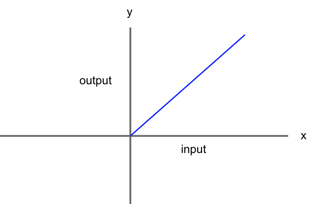
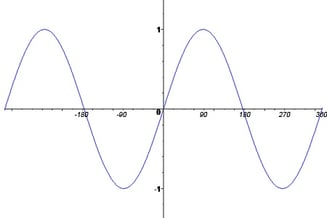
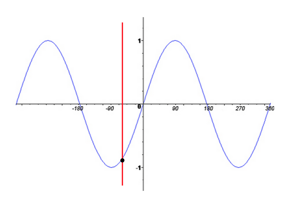
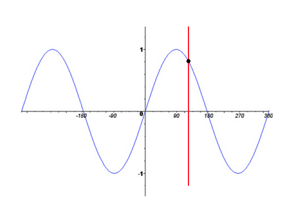
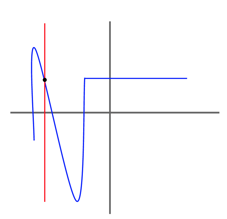
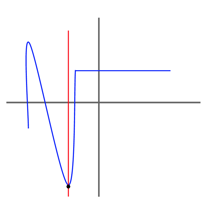
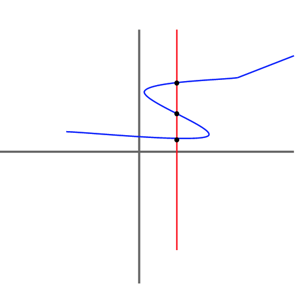
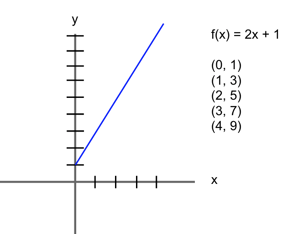
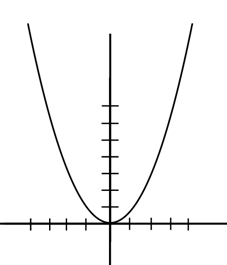
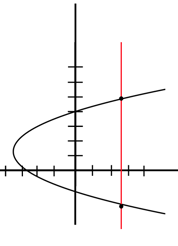
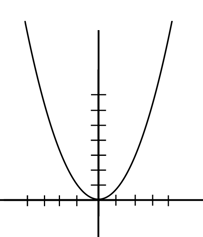
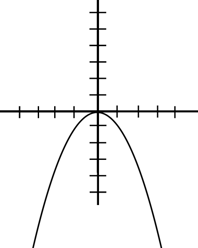
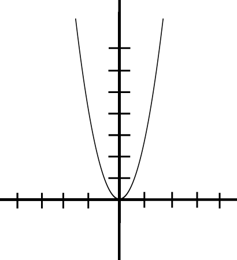
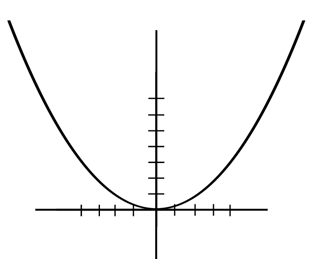
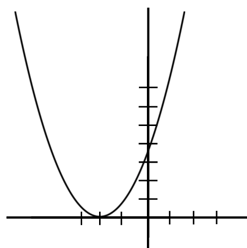
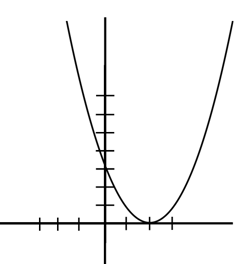
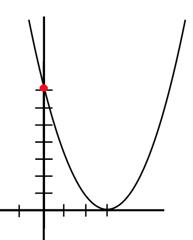
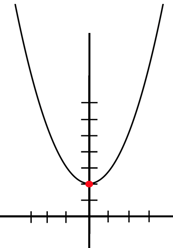
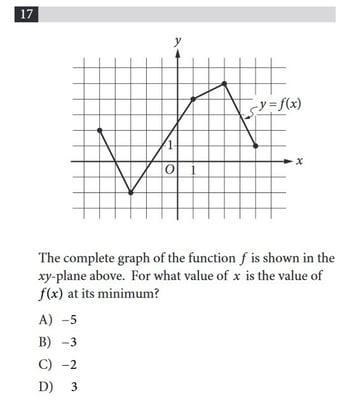
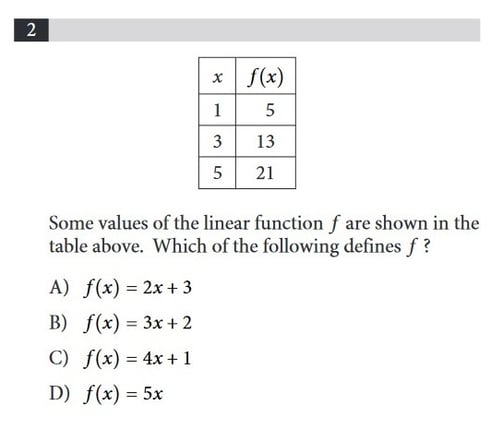
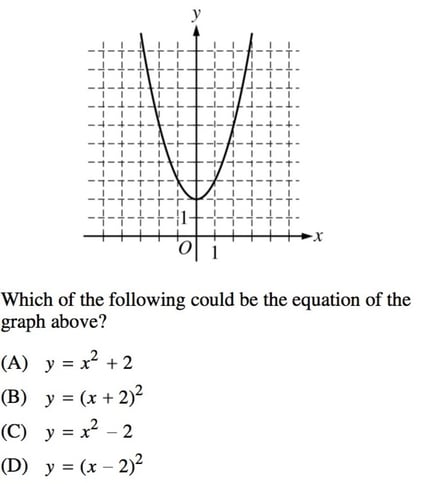
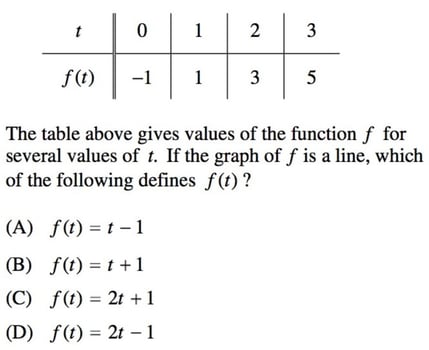
SAT functions have the dubious honour of being one of the trickiest topics on the Sat math section. Luckily, this is non because office problems are inherently more difficult to solve than whatsoever other math problem, but considering most students have but non dealt with functions as much as they have other Sat math topics. This means that the difference betwixt missing points on this seemingly tricky topic and acing them is merely a matter of practice and familiarization. And considering that part problems generally show upwardly on average of iii to four times per test, you lot will exist able to choice upwards several more than Saturday math points once you know the rules and workings of functions. This will be your complete guide to SAT functions. We'll walk you through exactly what functions mean, how to use, manipulate, and identify them, and exactly what kind of function problems you'll run into on the Sabbatum. Functions are a way to describe the relationship between inputs and outputs, whether in graph form or equation course. It may help to think of functions similar an assembly line or similar a recipe—input eggs, butter, and flour, and the output is a block. Well-nigh often you'll see functions written as $f(x) =$ an equation, wherein the equation tin can be as circuitous every bit a multivariable expression or every bit simple as an integer. Examples of functions: $f(x) = half-dozen$ $f(x) = 5x − 12$ $f(ten) = x^2 + 2x − 4$ Functions can always be graphed and different kinds of functions volition produce different looking graphs. On a standard coordinate graph with axes of $ten$ and $y$, the input of the graph will be the $x$ value and the output will exist the $y$ value. Each input ($x$ value) tin can produce only one output, merely one output can have multiple inputs. In other words, multiple inputs may produce the same output. Ane manner to think this is that you tin take "many to one" (many inputs to one output), merely Not "ane to many" (one input to many outputs). This means that a function graph can have potentially many $x$-intercepts, but only one $y$-intercept. (Why? Considering when the input is $x=0$, there can simply exist one output, or $y$ value.) A office with multiple $x$-intercepts. You lot tin ever test whether a graph is a function graph using this understanding of inputs to outputs. If you apply the "vertical line test," you can meet when a graph is a function or not, equally a function graph will NOT hitting more i indicate on any vertical line. No thing where nosotros draw a vertical line on our office, it will merely intersect with the graph a maximum of one time. The vertical line exam applies to every blazon of office, no matter how "odd" looking. Even "foreign-looking" functions will always laissez passer the vertical line test. But any graph that fails the vertical line test (by intersecting with the vertical line more once) is automatically Non a function. This graph is NOT a function, as it fails the vertical line test. Too many obstacles in the way of the rising works out as well for functions as it does for real life (which is to say: not well at all). At present that we've seen what functions exercise, let'southward talk about the pieces of a function. Functions are presented either by their equations, their tables, or by their graphs (called the "graph of the office"). Let's look at a sample function equation and break information technology downwards into its components. An instance of a function: $f(10) = x^ii + 5$ $f$ is the name of the function (Note: nosotros can call our function other names than $f$. This function is chosen $f$, but you may see functions written every bit $h(ten)$, $g(10)$, $r(ten)$, or annihilation else.) $(10)$ is the input (Note: in this example our input is called $x$, merely we can call our input anything. $f(q)$ or $f(\strawberries)$ are both functions with the inputs of $q$ and strawberries, respectively.) $x^two + 5$ gives usa the output once nosotros plug in the input value of $ten$. An ordered pair is the coupling of a particular input with its output for any given function. So for the example part $f(10) = x^2 + five$, with an input of iii, nosotros can have an ordered pair of: $f(x) = ten^2 + 5$ $f(3) = 3^two + 5$ $f(3) = 9+5$ $f(3) = 14$ So our ordered pair is $(three, xiv)$. Ordered pairs also act as coordinates, so nosotros can use them to graph our function. At present that we understand our role ingredients, let's see how we tin can put them together. We saw earlier that functions tin can have all sorts of different equations for their output. Allow'southward expect at how these equations shape their respective graphs. A linear function makes a graph of a directly line. This means that, if you accept a variable on the output side of the function, it cannot be raised to a power higher than 1. Why is this true? Because $x^2$ can give y'all a unmarried output for ii different inputs of $x$. Both $−3^two$ and $3^two$ equal ix, which means the graph cannot be a straight line. Examples of linear functions: $f(x) = x − 12$ $f(x) = 4$ $f(x) = 6x + 40$ A quadratic office makes a graph of a parabola, which means information technology is a graph that curves to open either upwardly or downwards. It as well means that our output variable will always be squared. The reason our variable must be squared (not cubed, not taken to the power of ane, etc.) is for the same reason that a linear role cannot be squared—because two input values tin can be squared to produce the aforementioned output. For instance, remember that $3^two$ and $(−3)^2$ both equal ix. Thus we have two input values—a positive and a negative—that give us the same output value. This gives united states our curve. (Note: a parabola cannot open side to side considering it would have to cross the $y$-centrality more than than one time. This, as we've already established, would mean it was not a part.) This is Not a quadratic function, as it fails the vertical line test. A quadratic function is oftentimes written as: $f(x) = ax^2 + bx + c$ The $\bi a$ value tells us how the parabola is shaped and the direction in which it opens. A positive $\bi a$ gives us a parabola that opens upward. A negative $\bi a$ gives us a parabola that opens downwards. A big $\bi a$ value gives united states a skinny parabola. A pocket-size $\bi a$ value gives united states a wide parabola. The $\bi b$ value tells united states where the vertex of the parabola is, left or right of the origin. A positive $\bi b$ puts the vertex of the parabola left of the origin. A negative $\bi b$ puts the vertex of the parabola right of the origin. The $\bi c$ value gives us the $y$-intercept of the parabola. This is wherever the graph hits the $y$-axis (and will only ever exist i point). (Notation: when $b=0$, the $y$-intercept will also be the location of the vertex of the parabola.) Don't worry if this seems like a lot to memorize right now—with practice, agreement role problems and their components will become 2d nature. Set to go beyond simply reading virtually the Sat? Then you'll love the gratuitous five-day trial for our SAT Complete Prep program. Designed and written by PrepScholar SAT experts, our Saturday plan customizes to your skill level in over forty subskills so that yous can focus your studying on what will get you the biggest score gains. Click on the button below to try it out! Saturday function issues will always test you on whether or not you properly empathise the relationship between inputs and outputs. These questions volition generally fall into four question types: #1: Functions with given equations #2: Functions with graphs #3: Functions with tables #four: Nested functions There may be some overlap between the three categories, but these are the main themes you'll be tested on when it comes to functions. Permit's look at some existent Saturday math examples of each type. A part equation problem will give you a function in equation form and and then inquire you to use one or more than inputs to find the output (or elements of the output). In order to find a particular output, nosotros must plug in our given input for $ten$ into our equation (the output). And then if we desire to find $f(2)$ for the equation $f(x) = x + 3$, we would plug in 2 for $ten$. $f(x) = x + 3$ $f(2) = ii + iii$ $f(2) = v$ So, when our input $(x)$ is two, our output $(y)$ is 5. Now let's await at a real Sat example of this type: $one thousand(10)=ax^2+24$ For the office $thousand$ defined above, $a$ is a constant and $yard(4)=viii$. What is the value of $grand(-4)$? A) eight B) 0 C) -i D) -viii We can start this trouble by solving for the value of $a$. Since $g(four) = eight$, substituting four for $ten$ and 8 for $g(x)$ gives united states of america $8= a(four)^2 + 24 = 16a + 24$. Solving this equation gives us $a=-ane$. Next, plug that value of $a$ into the function equation to get $yard(x)=-x^ii +24$ To find $g(-4)$, we plug in -4 for $ten$. From this we get $g(-four)=-(-four)^ii + 24$ $g(-4)= -sixteen + 24$ $yard(-4)=8$ Our concluding reply is A, eight. A role graph question will provide yous with an already graphed office and inquire you any number of questions nearly it. These questions will generally ask you to identify specific elements of the graph or accept yous find the equation of the function from the graph. Then long as you sympathise that $ten$ is your input and that your equation is your output, $y$, then these types of questions will not exist as tricky as they announced. The minimum value of a part corresponds to the $y$-coordinate of the point on the graph where it's everyman on the $y$-axis. Looking at the graph, we can see the function'south lowest point on the $y$-axis occurs at $(-3,-2)$. Since we're looking for the value of $ten$ when the function is at it'south minimum, we need the x-coordinate, which is -iii. So our terminal respond is B, -three. The 3rd mode you may encounter a function is in its table. You will be given a table of values both for the input and the output and and so asked to either find the equation of the role or the graph of the function. Oftentimes the all-time strategy for these types of questions is to plug in answers to make our lives simpler. This style, we don't have to actually detect the equation on our own—we can just exam which answer choices match the inputs and outputs we are given in our table. Let'due south test the second ordered pair, $(3,13)$ with each respond selection. For the correct answer, when we plug the $x$-value (3) into the equation, nosotros'll end upward with the correct $y$-value (xiii). A) $f(x) = 2(three) +3 = 9$. This equation is incorrect since ix doesn't equal 13. B) $f(10) =3(3) +2 = 1$. This equation is also incorrect. C) $f(ten) = 4(3) +1=13$. It'southward a lucifer! This equation is correct then far. D) $f(x)= 5(3)= xv$. This equation is also incorrect. It looks like C is the correct answer choice, but let'south plug the beginning and third ordered pairs in to make sure. For the kickoff ordered pair $(i,5)$: $f(ten) = four(ane) +i=5$ That's correct! For the third ordered pair $(5,21)$ $f(x) = four(5) +1=21$ That'southward also correct! Our final answer is C, $f(x) = 4x +1$ The final type of function problem you might see on the Sabbatum is called a "nested" function. Basically, this is an equation within an equation. In society to solve these types of questions, think of them in terms of your social club of operations. You must always work from the inside out, so you must kickoff find the output for your innermost function. Once you've constitute the output of your innermost function, you can use that consequence as the input of the outer function. Let'southward expect at this in action to make more sense of this process. What is $f(g(10−ii))$ when $f(x) = x^two − half-dozen$ and $g(x) = 3x + four?$ A. $3x − 2$ B. $3x^2 + 12x − 6$ C. $9x^2 + 24x + 10$ D. $9x^ii − 12x + 4$ Eastward. $9x^two − 12x − two$ Because $thousand(x)$ is nested the deepest, we must find its output before nosotros can find $f(g(ten−ii))$. Instead of a number for $x$, we are given some other equation. Though this may look different from before problems, the principle is exactly the aforementioned—replace whatsoever input nosotros have for the variable in the output equation. $g(x) = 3x + 4$ $g(x−2) = 3(x−2) + 4$ $yard(x−two) = 3x − six + four$ $thousand(x−2) = 3x − ii$ So our output of $yard(x−ii)$ is $3x−ii$. Again, this is an equation and not an integer, merely it nonetheless works as an output. At present we must cease the problem by using this output of $g(x)$ equally the input of $f(10)$. (Why do we do this? Because nosotros are finding $f(g(10))$, which positions the event/output of $g(ten)$ as the input of $f(x)$.) $f(10) = x^2 − half-dozen$ $f(g(x−2)) = (3x−ii)^2 − 6$ Now, nosotros have a fleck of a complication here in that nosotros must square an equation. If you call up your exponent rules, you know you lot cannot simply distribute the square across the elements of the equation; you must square the entire expression. And then let's accept a moment to expand $(3x−ii)^2$ before we find the solution for the entire equation. $(3x − 2)^2$ $(3x − ii)(3x − 2)$ $(3x*3x) + (3x*-2) + (−2*3x) + (−two*-2)$ $9x^2 − 6x − 6x + 4$ $9x^2 − 12x + 4$ Now, permit united states of america add this expanded form of the equation back into the output. $f(g(x−ii)) = (9x^2 − 12x + 4) − 6$ $f(g(ten−2)) = 9x^2 − 12x − ii$ So our final solution for $f(g(x−2))$ is $9x^ii − 12x − 2$. Our final answer is E, $9x^2 − 12x − 2$. Functions within functions, dreams within dreams. Make certain not to lose yourself along the fashion. Now that you lot've seen all the unlike kinds of function problems in action, let'south wait at some tips and strategies for solving role problems of diverse types. For clarity, we've carve up these strategies into multiple sections—tips for all part problems and tips for function issues by type. So let's look at each strategy. #1: Continue careful rail of all your pieces and write everything downward Though it may seem obvious, in the heat of the moment information technology can be far too easy to confuse your negatives and positives or misplace which piece of your function (or graph or table) is your input and which is your output. Parenthesis are crucial. The creators of the SAT know how easy it is to go pieces of your role equations confused and mixed around (especially when your input is as well an equation), so keep a sharp center on all your moving pieces and don't effort to exercise part problems in your head. #2: Use PIA and PIN as necessary Equally we saw in our function table problem above, information technology tin can salve a adept deal of effort and energy to use the strategy of plugging in answers. You can too employ the technique of plugging in your own numbers to test out points on function graphs, work with any variable function equation, or work with nested functions with variables. For instance, let's look at our earlier nested function trouble using PIN. (Remember—most any time a problem has variables in the answer choices, you can utilize PIN). What is $f(1000(10−2))$ when $f(x)= x^2 − six$ and $g(x) = 3x + 4?$ A. $3x^2 + 24x − 2$ B. $3x^2 + 12x − 6$ C. $9x^2 − 24x + 10$ D. $9x^two − 12x + four$ East. $9x^two − 12x − 2$ If we call up how nested functions piece of work (that we ever piece of work inside out), and then we can plug in our own number for $10$ in the function $1000(ten−two)$. That style, nosotros won't have to work with variables and tin can use real numbers instead. So let us say that the $x$ is the $g(10−ii)$ function is v. (Why 5? Why not!) Now $x−ii$ will be $five−3$, or 3. This means $1000(x−2)$ will exist $m(three)$. $thou(x−two) = 3x + 4$ $g(three) = 3(3) + 4$ $g(three) = 9 + 4$ $g(3) = xiii$ At present, let united states of america plug this number as the value for our $thou(10−two)$ function into our nested function $f(thou(x−ii))$. $f(x) = x^2 − 6$ $f(g(3)) = (13)^2 − 6$ $f(g(three)) = 169 − 6$ $f(g(3)) = 163$ Finally, let us test our answer choices to come across which one matches our found answer of 163. Let us, every bit usual when using PIA or PIN, start in the middle with answer pick C. $9x^ii − 24x + x$ At present, nosotros replace our $x$ value with the $x$ value we chose originally—5. $9x^two − 24x + x$ $ix(5)^two − 24(5) + 10$ $9(25) − 120 + 10$ $225 − 120 + 10$ 115 Unfortunately, this number is too modest. Let us try answer selection D instead. $9x^2 − 12x + 4$ $ix(v)^ii − 12(5) + 4$ $9(25) − sixty + 4$ $225 − lx + 4$ $165 + four$ 169 This value is still too large, but we tin can see that it is awfully close to the final answer we want. Just past looking over our answer choices, nosotros tin can run into that answer choice E is exactly the same expression as answer choice D, except for the final integer value. If we were to subtract 2 from 165 instead of adding four (as nosotros did with reply choice D), nosotros would become our final answer of 163. Every bit you tin can see. $9x^two − 12x − two$ $9(5)^2 − 12(5) − ii$ $9(25) − 60 − ii$ $225 − sixty − 2$ $165 − 2$ 163 And so our final answer is Eastward, $9x^2 − 12x − 2$. #iii: Practice, practice, practice Finally, the only way to get truly comfortable with any math topic is to practice as many dissimilar kinds of questions on that topic equally yous can. If functions are a weak expanse for you lot, then be certain to seek out more practice questions. #ane: Offset by finding the $\bi y$-intercept By and large, the easiest place to begin when working with function graphs and tables is by finding the y-intercept. From there, you tin frequently eliminate several dissimilar respond choices that do not lucifer our graph or our equation (as we did in our earlier examples). The y-intercept is almost always the easiest piece to find, and so information technology's always a good place to brainstorm. #two: Examination your equation confronting multiple ordered pairs It is e'er a skilful idea to detect two or more points (ordered pairs) of your functions and examination them against a potential office equation. Sometimes one ordered pair works for your graph and a 2nd does non. Y'all must lucifer the equation to the graph (or the equation to the table) that works for every coordinate betoken/ordered pair, non just 1 or two. #one: Ever work inside out Nested functions can look beastly and difficult, but take them piece past piece. Work out the equation in the centre and and so build outwards slowly, so as not to go whatever of your variables or equations mixed upward. #two: Recall to FOIL It is quite mutual for SAT to make you square an equation. This is because many students go these types of questions wrong and distribute their exponents instead of squaring the entire expression. For instance, let's say that you must square an expression. Square the expression $x + 3$. We are told to square the entire expression, so we would say: $(ten + 3)^2$ Now you lot must FOIL this out properly. $(ten + three)(x + 3)$ $(10*ten)+(iii*10)+(3*x)+(3*3)$ $x^2 + 3x + 3x + 9$ $x^2 + 6x + 9$ The final expression, once you accept squared $x + iii$, is: $x^2 + 6x + nine.$ (Notation: It is a common error for students to distribute the square and say: $(x + 3)^2 = x^2 + 9$ only this is wrong . Do non fall into this kind of trap!) Yous're all leveled-upwards—time to fight the big boss and put knowledge to action! At present let's put your role knowledge to the test against real Sabbatum math problems. 1. Allow the office $f$ be defined bye $f(x)=5x-2a$, where $a$ is a abiding. If $f(10)+f(5)=55$, what is the value of $a$? A) -5 B) 0 C) 5 D) 10 ii. A function $f$ satisfies $f(2)=three$ and $f(iii)=5$. A function $g$ satisfies $g(3)=2$ and $chiliad(five)=half-dozen$. What is the value of $f(g(iii))$? A) 2 B) three C) five D) 6 three. 4. Answers: C, B, A, D Respond Explanations: 1. Every bit you can see hither, we are given our equation as well equally ii inputs and their combined output. We must apply this cognition to find an chemical element of our output (in this case, the value of $a$.) So let us find our outputs for each input we are given. $f(ten) = 5x − 2a$ $f(10) = 5(10) − 2a$ $f(10) = fifty − 2a$ And $f(x) = 5x − 2a$ $f(5) = 5(five) − 2a$ $f(5) = 25 − 2a$ Now, let us set the sum of our two outputs equal to 55 (every bit was stipulated in the question). $50 − 2a + 25 − 2a = 55$ $75 − 4a = 55$ $−4a = −xx$ $a = five$ Our final answer is C, $a=5$. 2. Nosotros're told in the question that $g(3)=ii$. To observe the value of $f(one thousand(3))$, we need to substitute 2 for $thousand(3)$. We'll employ that value in the $f(x)$ equation. Substituting 2 for $g(three)$ gives us $f(g(iii))$ = $f(two)$. We're besides told that $f(two)=three$, so that means iii is the correct reply. Our concluding answer is B, 3. 3. As per our strategies, we volition commencement by finding the $y$-intercept. We tin can see in this graph that the $y$-intercept is +2, which ways we can eliminate answer choices C and E. (Why did nosotros eliminate respond option E? Considering it had no $y$-intercept, which means that its $y$-intercept would be 0). We tin see that the vertex of the graph is at $x=0$ and then it is non shifted to the right or left of the $y$-axis. This means that, in our quadratic equation $ax^2+bx+c$, our $b$ value has to be 0. If it were annihilation other than 0, our graph would exist shifted left or right of the $y$-centrality. Now answer choices B and D are squaring expressions, then permit u.s.a. properly FOIL them in order to run across the equation properly. Respond pick B gives us: $y=(x+2)^2$ $y=(10+two)(x+2)$ $y=x^ii+2x+2x+4$ $y=x^ii+4x+4$ This equation would give us a parabola whose $y$-intercept was at +4 and whose vertex was positioned to the left of the $y$-axis (retrieve, a positive $b$ value shifts the graph to the left.) We can eliminate reply choice B. By the aforementioned token, we can also eliminate answer option D, as it would requite us: $y=(x−2)^2$ $y=(10−2)(x−2)$ $y=ten^2−4x+4$ Which would requite us a graph with a $y$-intercept at +4 and a vertex positioned to the right of the $y$-axis. By process of elimination, we are left with answer choice A. Only, for the sake of double-checking, let u.s. test a coordinate point on the graph confronting the formula. We already know that our equation matches the coordinate points of $(0, 2)$, equally that is our $y$-intercept, but there are several more than places on the graph that striking at even coordinates. By looking at the graph, we can see that the parabola hits the coordinates $(i, iii)$, so permit u.s.a. test this bespeak by plugging our input (1) into our equation, in hopes that it will match our output of 3. $y=x^2+ii$ $y=(1)^2+ii$ $y=1+3$ $y=three$ Our equation matches two sets of ordered pairs on the graph. We can reasonably say that this is the correct equation for the graph. Our last solution is A, $y=x^2+2$ iv. Instead of using $x$ for our input, this problem has us use $t.$ If y'all become very used to using $f(x)$, this may seem disorienting, so you can always rewrite the problem using $x$ in identify of $t$. In this case, we will continue to use $t$, simply so that we tin continue the problem organized on the page. Commencement, allow us find the $y$-intercept. The $y$-intercept is the point at which $x=0$, so we tin see that we are already given this with the kickoff set of numbers in the table. When $t=0$, $f(t) = −1$ Our $y$-intercept is therefore -1, which means that we can automatically eliminate answer choices B, C, and Due east. Now let's use our strategy of plugging in numbers again. Our reply choices are between A and D, so permit us kickoff test A with the 2nd ordered pair. Our potential equation is: $f(t) = t − ane$ And our ordered pair is: $(1, 1)$ So let usa put them together. $f(t) = t − 1$ $f(ane) = i − ane$ $f(1) = 0$ This is incorrect, as information technology would hateful that our output is 0 when our input is i, and nevertheless the ordered pair says that our output will be one when our input is 1. Reply choice A is incorrect. By process of emptying, permit united states try answer choice D. Our potential equation is: $f(t) = 2t − 1$ And our ordered pair is over again: $(1, 1)$ So let united states put them together. $f(ane) = 2(1) − 1$ $f(1) = 2 − 1$ $f(1) = 1$ This matches the input and output we are given in our ordered pair. Reply choice D is right. Our final reply is D, $f(t) = 2t − 1$ You lot did it! High fives all around. Many students have not dealt a lot with functions, merely don't let these kinds of questions intimidate or confuse you when yous see them on the SAT. The principles behind functions are a unproblematic affair of input, output, and plugging in values. The exam will try to dirty the waters when they can, but always remember that these questions will appear to be more than complex than they truly are. Though it tin can exist like shooting fish in a barrel to brand a fault with your signs or variables, the actual problems are uncomplicated at their core. So pay close attending, double-check your work, and you lot'll soon exist able to work through functions problems with picayune trouble. Speaking of quadratic functions, how's your grasp of completing the square? Learn how and when to complete the foursquare with this guide. Phew! Knowing your functions means knowing a meaning portion of the Sat math department (round of adulation to you lot!), just there are so many more topics to cover. Have a expect at all the topics you'll be tested on in the Sabbatum math section and and then mosey on over to our math guides to review any topic you experience rusty on. Not feeling confident about your exponent rules? How about your understanding of polygons? Need to review your slopes? Whatever the topic, we've got you covered! Looking for help with more basic math? Refresh your memory on the distributive property, perfect squares, and how to find the mean of a set of numbers here. Think you lot demand a math tutor? Check out our guides on how to notice the tutor that best meets your needs (and your budget). Running out of time on the Sabbatum math section? Not to worry! Nosotros have the tools and strategies to help you shell the clock and maximize your point gain. Trying for a perfect score? Check out how to button your score to its maximum potential with our guide to getting an 800 on the Sat math, written past a perfect scorer. Want to improve your SAT score by 160 points? Check out our best-in-class online Saturday prep program. Nosotros guarantee your money dorsum if you don't amend your Sabbatum score by 160 points or more. Our program is entirely online, and it customizes what yous study to your strengths and weaknesses. If you lot liked this Math strategy guide, you'll love our program. Along with more than detailed lessons, y'all'll become thousands of practice problems organized by individual skills and so you learn most effectively. We'll also give you a pace-by-step plan to follow and so you lot'll never be dislocated most what to study adjacent. Check out our five-solar day free trial: 
What Are Functions and How Do They Piece of work?

Function Terms and Definitions

Different Types of Functions
Linear Functions
Quadratic Functions


Typical Part Problems
Role Equations
Function Graphs
Function Tables
Nested Functions

Strategies for Solving Office Issues
Strategies for All Office Problems:
For Function Graphs and Tables:
For Function Equations and Nested Equations:

Test Your Knowledge

The Have Aways
What's Side by side?


Courtney scored in the 99th percentile on the Saturday in high school and went on to graduate from Stanford University with a caste in Cultural and Social Anthropology. She is passionate virtually bringing education and the tools to succeed to students from all backgrounds and walks of life, as she believes open educational activity is one of the peachy societal equalizers. She has years of tutoring feel and writes artistic works in her gratis time.
Source: https://blog.prepscholar.com/functions-on-sat-math-linear-quadratic-algebra
0 Response to "Sat Everything You Need to Know About Parabolas"
Post a Comment