what lead to the spread of the black death
Abstract
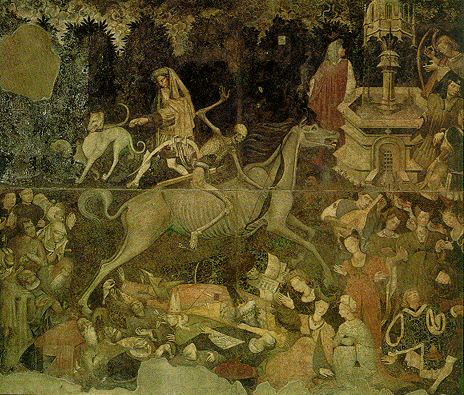
In the fourteenth century, Europe suffered numerous catastrophes that would become down in history as "The Four Horsemen of the Apocalypse"; a reference to the volume of Revelation in which iv swell ordeals which Earth had to endure in its final days earlier judgement. The Black Death stands out every bit the near dramatic and lifestyle irresolute event during this century. This was a widespread epidemic of the Bubonic Plague that passed from Asia and through Europe in the mid fourteenth century. The first signs of the Black Plague in Europe were nowadays around the fall of 1347. In the span of three years, the Black Death killed one third of all the people in Europe. This traumatic population change coming into the Tardily Middle Ages acquired great changes in European culture and lifestyle.
Historical Background
The Black Expiry was 1 of many catastrophes to occur following an increase in population during the High Middle Ages (g-1300). The population of Europe grew from 38 million to 74 million in this time. Prior to the onset of the fourteenth century turmoil, Europe seemed to be in a state of growth in both agriculture and structure in society. Cities began to rise with artisans, farmers, and other crafts people specializing in their own field of piece of work. The daily life contact between European people in the cities and surrounding villages facilitated the spread of this disease, as people did not possess sufficient medical knowledge to foreclose the spread of the affliction with any swell success. The conditions in the cities also gear up the stage for disease. Waste accumulated in the streets for lack of sewer systems. Houses were crowded side by side to each other. I could not use the rivers for drinking water due to pollution. With all of these conditions arising from the High Centre Ages, it was only a matter of time earlier the population was curbed by disaster. The Black Death marks the barrier between the High Middle Ages and the Late Centre Ages, and the departure in Europe before and after the Black Death is clear.
Enquiry Report
The origins of the Blackness Expiry can exist traced dorsum to the Gobi Desert of Mongolia in the 1320s. The crusade of this sudden eruption of the plague is non exactly known. From the desert, it spread out in all directions. Of near importance was the spread e to China. China suffered an emergence of bubonic plague during the early 1330s. During the expansion of trade during the Early and High Middle ages, trade routes with Red china were strengthened and ventured greatly. European traders, especially those from the Italian city states, traveled the Black Sea region regularly. Surviving documents bear witness that one group of traders from Genoa arrived in Sicily In October of 1347, fresh from a voyage to China. This was about probable the introduction of the plague to European lands. Forth with the Chinese goods on board, the traders carried the bacterium yersinia pestis in the rats on board likewise every bit in some of the sailors themselves. The Black Decease had arrived in Europe.
From Sicily, the plague spread at an alarming rate. The speed at which information technology spread and killed, likewise as the horror which accompanied the diseased, acquired a panic in the Italian population. Families were forced to abandon members who were sick. Lawyers refused to form wills for the dying. Entire monasteries were wiped out when they attempted to care for the dying, which caused not bad fear in charitable organizations. Other European countries looked toward Italians as being the cause of the plague, and there were many incidences of healthy Italian travelers and traders being exiled from villages or even killed out of fear of the plague spreading outside Italy. These measures proved futile, and the plague spread farther and farther n. Wherever trade routes existed, usually the plague would follow, radiating out from Italy. The Plague reached French republic shortly afterwards Italia. Marseilles felt the effects in January of 1348 and Paris was infected in summer of the same twelvemonth. England felt the effects in September of 1348. 1348 Europe suffered the well-nigh. By the terminate of 1348, Germany, France, England, Italy, and the low countries had all felt the plague. Kingdom of norway was infected in 1349, and Eastern European countries began to fall victim during the early 1350s. Russian federation felt the effects later in 1351. Past the end of this circular path effectually Europe, one tertiary of all people in the infected areas had perished.
The people of Europe did not know that such a cataclysm was the issue of a microscopic bacillus bacterium. This organism was not new to the world in the fourteenth century, it had existed for millions of years prior. Europe really had already felt a blow from the aforementioned plague earlier in the 6th century. The emergence at this particular time has unknown causes, yet some speculate that the "mini water ice age", a climatic change felt in Europe prior to the Black Death, may have served in the process. Rodents are very susceptible to infection from the leaner, specially common rats. These rats are also host to parasitic fleas, which alive off of the blood of other animals. The flea is non affected by the bacterium, still still carries information technology in the blood extracted from the rat host in its digestive tract. The flea'southward power to comport the illness without death makes it a perfect conduit of transfer from organism to organism. When these rats inhabit urban areas or boats in order to live off of stored food supplies, they bring the fleas with them. Fleas exit the rat, which also dies shortly from the disease, and moves on to a new host; humans.
 Once the flea bites a man, infected blood from the rat is introduced to the good for you blood of the human being, and the bacteria spreads. Death occurs in less than a week for humans. A high fever, aching limbs, and fatigue mark the early stages of infection. Eventually, the lymph nodes of the cervix, groin, and armpit areas peachy and plow black. Those black swellings on victims are what give the Black Death its name. The victim begins to vomit claret and in some instances suffer hysteria from fever and terror. Exposure to any torso fluids means exposure to the bacterium, and thus spreading the affliction is very easy through cough victims. The victim dies shortly subsequently the lymph nodes keen until bursting inside the body. Within a European village, by the fourth dimension the initial carrier of the disease had perished, the illness would take already taken early on stages in several other individuals, making prevention extreamly difficult.
The cycles of the seasons corresponded to cycles of infection. Every bit winter approached, colder temperatures killed fleas and caused rats to seek dormancy. This gave the faux appearance of an "all clear" in areas that had been ravaged past plague the previous summer. The disease was non gone, it was simply fallow for a few months. Europe was then taken by surprise with new outbreaks in new areas as temperatures again made for a hospitable environs for flea and rat populations.
The idea that the Black Death was solely caused by the bubonic strain of plague has been questioned. The bubonic plague is actually the weakest strain of known plagues. The other two strains are the septicaemic plague, which infects the circulatory organisation in victims, and the pneumonic plague, which infects the respiratory system. The fact that accounts from the fourth dimension signal that the Blackness Death killed virtually all infected people raises dubiousness. The bubonic plague is non every bit fatal compared to the other two strains (which have mortality rates close to 100%). The consideration to brand is that malnutrition plays a major role in the furthering of the consequences of infection. Those groups most ravaged past the Black Death had already suffered from famine earlier in the fourteenth century as storms and drought caused crop failures. These malnourished peasants brutal victim with piddling resistance from their weak immune systems.
Most outset hand written accounts that are present today read similar this 1 from the site of the first plague cases in Italia, Messina: "Here not only the "burn blisters" appeared, but there developed gland boils on the groin, the thighs, the arms, or on the cervix. At first these were of the size of a hazel nut, and developed accompanied by violent shivering fits, which soon rendered those attacked so weak that they could not stand up upwardly, but were forced to lie in their beds consumed by vehement fever. Shortly the boils grew to the size of a walnut, so to that of a hen's egg or a goose's egg, and they were exceedingly painful, and irritated the torso, causing the sufferer to vomit blood. The sickness lasted three days, and on the fourth, at the latest, the patient succumbed". The Italian writer Giovanni Boccaccio wrote graphically about the Black Expiry in The Decameron. He describes how "More wretched notwithstanding were the circumstances of the common people and , for a great part, of the middle course, for, confined to their homes either by promise of safety or by poverty, and restricted to their own sections, they fell sick daily past thousands. At that place, devoid of help, or care, they dies almost without redemption. A corking many breathed their last in the public streets, day and dark; a large number perished in their homes, and information technology was just by the stench of their decomposable bodies that they proclaimed their expiry to their neighbors. Everywhere the urban center was teeming with corpses. "
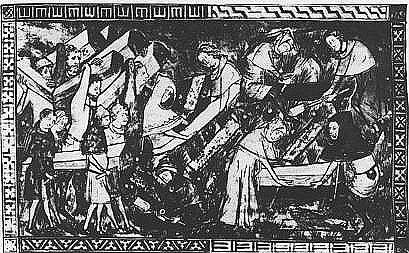
When the plague offset entered an area, mourners of the deceased still prepared coffins and conducted ceremonies for their loved ones. Inside weeks, in response to desperation to control the sickness besides as sheer volume of the dead, officials had to resort to mass graves. There was non nearly enough consecrated basis for each victim to have an individual plot, and so enormous trenches were dug into which layer upon layer of dead bodies were lain. The trench was topped off with a minor layer of soil, and the morbid process continued. Pope Clement Vi even consecrated the unabridged Rhone river and then that corpses could exist thrown into it for lack of earth. Those in the peasant course who saw horrors such as these could not accept that a loving God could inflict such a plague upon His people, and considered it to exist a punishment from an angry God. Some peasants resorted to magic spells, charms, and talismans. Some people burned incense or other herbs as they believed that they overpowering smell of the dead victims was the source of the disease. Some people fifty-fifty tried to "bulldoze the disease away" with audio from church bells and catechism fire. Jews were easy targets for people to blame, and numerous instances of Jew persecution and execution occured. Churchmen, and public officials considered the disease to be just that; a disease. They took measures to quarantine the infection by walling up homes that had members with affliction. In Venice and Milan, ships coming in from areas in which disease had been rampant were diverted to divide islands. This activeness had limited success, only still prevented the disease more than than in other areas which did not enforce this type of quarantine. The wealthy were able to leave infected areas and established residence afar. A rather ingenious method of prevention was taken upward past pople Clement 6 who sat between ii large fires at his home in Avignon. Considering excess rut destroys bacterium, he was taking the safest, though slightly ludicrous, measures. In the long run, the just "cure" for this epidemic was time, and it seemed, the shortage of new hosts for the disease.
When the Black Decease had finally passed out of Western Europe in 1350, the populations of unlike regions had been reduced greatly. Some villages of Germany were completely wiped out, while other areas of Deutschland remained virtually untouched. Italian republic had been hit the hardest past the plague because of the dumbo population of merchants and agile lifestyle inside the city states. For example, the city state of Florence was reduced by one/three in population within the starting time six months of infection. By the end, as much every bit 75% of the population had perished, which left the economy in shambles. Widespread decease was not limited to the lower classes. In Avignon, 1/3 of the cardinals were dead. Overall, 25 million people died in just under five years between 1347 and 1352. Information technology is important to realize that the plague had not entirely vanished, just the primary epidemic. Recurrences of bubonic plague occurred every and then often and had a traumatic consequence on population even then. The plague did not entire vanish as we know it until the belatedly fifteenth century, which immune for populations to finally begin to ascent to the heights that they were at before the Horseman of Death came to Europe.
Historical Significance
The Blackness Death brought about great change in attitude, culture, and general lifestyle in Europe. A group of individuals known as the Flagellants traveled from boondocks to boondocks chirapsia themselves and inflicting any other penalisation that they believed would help atone for the wrongs that they believed had brought well-nigh God's wrath. This group was condemned by Pope Clement VI in 1349 and was crushed soon after. The full general morbid attitude of the people following the disaster was shown in Tomb engravings. Instead of the traditional engravings of the enclosed beingness dressed in armor or fine outfits, now carved images of decomposable bodies were present. Paintings of the afterward fourteenth century also demonstrate morbid obsessions of those who had endured the fourth dimension of the plague. Ane of the greatest furnishings of the Blackness Death was in the realm of laboring classes. The shortage of labor to piece of work land for landowners created opportunity for those living in areas afar as subsistence farmers. They moved to farming communities and along with already present farming peasants, were able to win improve working weather condition through negotiating and rebelling against landowners. This set Western Europe forth the path of diverging classes. The main theme that one can derive from the Black Expiry is that bloodshed is ever present, and humanity is fragile, attitudes that are ever present in Western Nations.
References
Marks, Geoffrey J. The Medieval Plague; the Black Decease of the Middle Ages. Doubleday, New York 1971.
Oleksy, Walter One thousand.The Black Plague New Yoirk, F. Watts 1982.
Dunn, John M.Life During the Black Death Lucent books inc. 2000.
Rowling, Marjorie. Life in Medieval Times Perigee, New York 1979.
Tuchman, Barbara W. A Distant Mirror; the Calamitous 14th Century Random House, New York, 1978
Web Resources
The Boise State University Black Death Page. Covers all aspects.
An elaborate page with a narrative type explanation of the Bubonic plague
Forham University traces the plague and how it relates to the Jews in the 14th Century.
A page which relates the famines and plagues of the 14th Century
A page by Brigham Immature University with all-encompassing information and accounts
Source: https://academic.mu.edu/meissnerd/plague.htm
0 Response to "what lead to the spread of the black death"
Post a Comment